


TL;DR
- No, you should not put regular plastic in an air fryer.
- Most plastic containers, takeaway containers, lids, wrap, and storage bowls can melt, warp, smell, or contaminate food when exposed to hot air and high heat.
- Microwave-safe does not mean oven-safe or air fryer safe.
- Use ceramic, borosilicate glass, metal, or high-quality silicone only when they are explicitly labeled for oven use or air fryer use.
- When unsure, check the user manual and avoid using the wrong container.
Direct Answer
No, you should not put regular plastic in an air fryer. An air fryer works like a small convection oven, using circulating air and dry heat at high temperatures. Most plastic containers are not designed to handle that heat and may melt, warp, release a chemical smell, or touch the heating element. [USDA FSIS]
Why Plastic Should Not Go in an Air Fryer
Plastic should not go in an air fryer because the appliance can often reach 200°C or 400°F during cooking. That level of high heat can melt many containers that are safe for storage or microwave reheating.
An air fryer does not heat like a microwave. It blows hot air around food, which is why the surface can turn crispy. This cooking style is called convection, and it exposes the container, tray, or pan to steady heat from every side.
The rule of thumb is simple: if the item is not labeled oven-safe or specifically made for an air fryer, do not use it.
What Happens If You Put Plastic in an Air Fryer?
If you put plastic inside an air fryer, it may melt, soften, warp, smoke, or start to burn. It may also stick to the air fryer basket, drip onto the tray, or damage the non-stick coating of your basket.
Plastic can also create a strong smell. If you notice a chemical smell, turn off the appliance, unplug it if safe, and let everything cool before touching anything inside the unit.
Possible problems include:
| Problem | Why it matters |
|---|---|
| Melting | Plastic may stick to the basket or tray |
| Warping | The container may collapse onto food |
| Smoke | Heat damage can create odor and fumes |
| Food contamination | Melted material can touch food |
| Fire risk | Loose or thin plastic may catch fire near direct heat |
| Appliance damage | Melted plastic can reach the heating area |
USDA says foam trays and plastic wraps used with fresh meat are not meant to be heated and may melt when touching hot food, allowing chemical migration into food. [USDA FSIS]
No, microwave-safe plastic is not automatically oven-safe or safe for air fryer use. A microwave-safe label only tells you the item is intended for certain microwave conditions, not for steady dry heat inside an oven air fryer.
USDA’s packaging glossary says polypropylene is used for microwave-only heating but is not heat stable for conventional ovens.
That matters because an air fryer behaves more like a convection oven than a microwave. So, a storage bowl that works for soup in the microwave may still fail inside an air fryer’s cooking chamber.
Are Any Plastic Containers Air Fryer Safe?
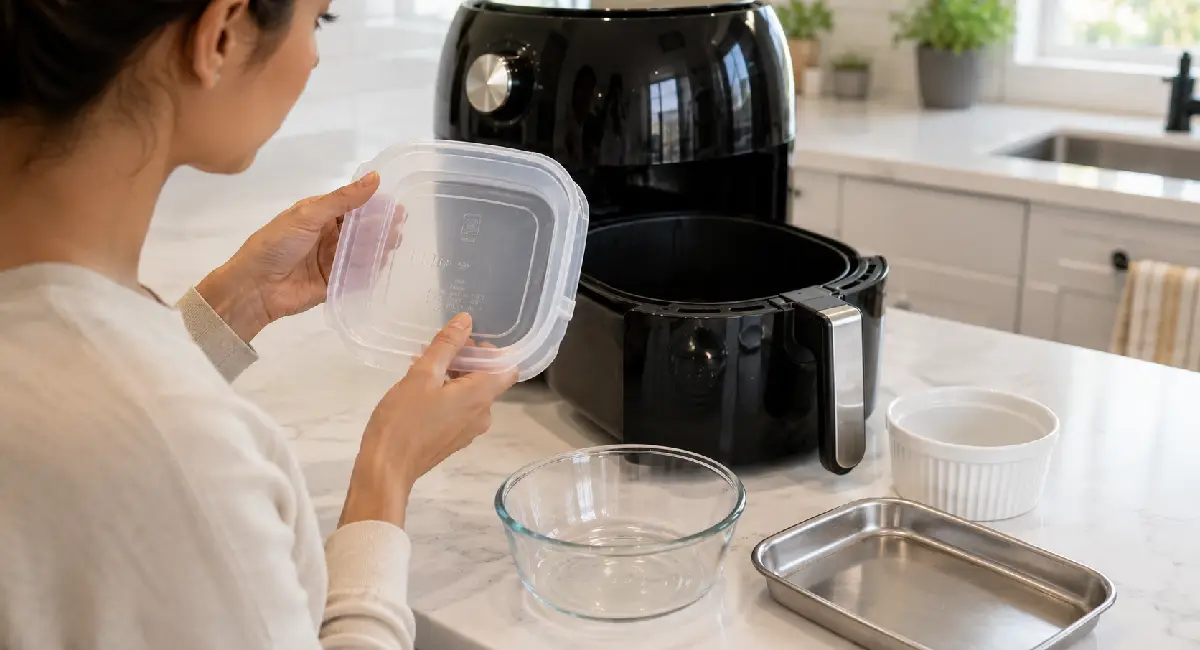
Most plastic containers never be used in an air fryer. A rare exception would be a food-contact item that is clearly designed for high-heat cooking and marked for the exact temperature and use.
The FDA explains that food-contact materials are reviewed based on their intended condition of use, including the expected food-contact temperature. [FDA]
So the label matters. A container must say more than “food safe.” It should be labeled as oven-safe, rated for the temperature you plan to use, and suitable for the type of cooking.
Even then, it is usually best to stick with safer common materials like metal, ceramic, oven-safe glass, or silicone made for air frying.
What Containers Are Safe to Use?
The safest containers for an air fryer are usually metal, ceramic dishes, oven-safe glass, and silicone molds that are made to withstand temperatures used during cooking.
| Material | Air fryer use | Safety note |
|---|---|---|
| Metal pan | Usually good | Must fit and not block airflow |
| Ceramic | Often safe | Use only if oven safe |
| Small ceramic dish | Good for baked foods | Keep away from the heating element |
| Borosilicate glass | Sometimes safe | Must be oven-safe and not damaged |
| Silicone | Often safe | Must be heat-resistant and food-grade |
| Parchment | Sometimes safe | Must be weighed down by food |
| Plastic | Usually unsafe | Avoid unless explicitly rated for oven/high heat |
These containers are safe to use only when they match your model, food, and temperature.
Why Oven-Safe Matters
Oven-safe means the cookware is designed to handle the heat of an oven. Since an air fryer uses hot air at high speed, the same idea applies.
A dish that is labeled oven-safe is more suitable than one labeled only for storage or microwave reheating. Still, you should always check the brand’s temperature limit.
For example, if your recipe uses 400°F, the cookware should be rated for at least 400°F. If the food sits close to the heating element, avoid tall containers or lids that may touch direct heat.
Best Alternatives to Plastic
The best air fryer containers depend on what you cook. For everyday cooking, choose materials that fit the basket and leave space for air to circulate.
Good alternatives:
- Oven-safe metal pan.
- Ceramic ramekin.
- Glass containers rated for oven heat.
- Borosilicate glass dish if the maker allows oven use.
- Silicone muffin cups.
- High-quality silicone molds.
- Perforated parchment paper.
- Accessories designed for air fryers.
Do not use lids unless they are heat-rated and allowed by the manual.
Can You Use Silicone in an Air Fryer?
Yes, you can use silicone in many air fryer recipes if it is food-grade, heat-resistant, and rated for the cooking temperature. Silicone cups and molds can work for muffins, egg bites, reheating, and small baked foods.
Still, not every silicone product is equal. Use only silicone made for baking or air fryer use. Avoid thin novelty molds that do not list a heat rating.
A silicone liner may help protect the basket, but it can also block airflow if it covers too much of the base.
Can You Use Ceramic in an Air Fryer?
Yes, ceramic can be used in an air fryer when the dish is oven-safe and fits properly. A small ceramic ramekin is useful for eggs, dips, baked oatmeal, or small desserts.
Do not use cracked ceramic. Also, avoid dishes that are too tall or too wide because they may block airflow.
Good spacing helps even cooking and improves the overall cooking experience.
Can You Use Glass Containers?
Yes, some glass containers can be used in an air fryer if they are oven-safe, heat-rated, and undamaged. Borosilicate glass may handle temperature changes better than some regular glass, but the manufacturer’s instructions still matter.
Do not move hot glass onto a cold wet counter. Sudden temperature changes can crack glass.
Also, do not assume freezer-safe or microwave-safe glass is automatically safe for an air fryer.
Can You Use Parchment in an Air Fryer?
Yes, parchment can be used in an air fryer if it is made for cooking, trimmed to fit, and held down by food. Loose parchment can lift into the heating area.
Use parchment only when it does not cover too many holes in the basket. If it blocks airflow, food may cook unevenly.
For fries and wings, the bare basket often works better. For sticky foods, a liner may help cleanup.
Can You Reheat Food in Takeaway Containers?
No, do not reheat food in takeaway containers inside an air fryer. Most plastic takeout boxes are designed for carrying food, not for air frying or higher temperatures.
Move the food into an oven-safe dish, metal pan, or approved silicone container first.
This is one of the most common mistakes people make when using an air fryer for leftovers.
What About the Plastic Handle or Exterior Parts?
Some air fryer parts may look plastic on the outside, but those parts are built into the appliance design. That does not mean you can add loose plastic cookware inside the cooking chamber.
The difference is location and testing. The outside handle is made for that appliance. A random storage container is not tested for heat exposure near the basket, fan, or heating element.
So, do not compare outer parts with cookware placed inside an air fryer.
How to Choose Air Fryer Safe Cookware
Choose cookware that is clearly air fryer safe, fryer safe, oven-safe, and rated for the recipe temperature. The label should be clear, not guessed.
Use this checklist:
| Safety check | Safe answer |
|---|---|
| Is it marked oven-safe? | Yes |
| Is it rated for 200°C / 400°F? | Yes |
| Is it for food contact? | Yes |
| Does it fit the basket? | Yes |
| Can air move around it? | Yes |
| Is it away from the heating element? | Yes |
| Is it allowed by the user manual? | Yes |
| Is it free from cracks or damage? | Yes |
These best practices reduce melting, smoke, and poor cooking results.
Why Airflow Still Matters
An air fryer needs space around the food and cookware. If the container is too large, it can block airflow and stop the air around the food from moving properly.
That matters because the appliance depends on circulating air, not just heat. If airflow is blocked, food may stay soft instead of crisp.
For safer results, use a low pan or small dish that leaves room on all sides.
What to Do If Plastic Melts Inside
If plastic melts inside the appliance, stop cooking right away. Turn the air fryer off, unplug it if safe, and let it cool completely.
Then:
- Remove the basket or tray.
- Do not scrape hot melted plastic.
- Open a window if there is odor.
- Let the appliance cool.
- Remove hardened plastic carefully.
- Check the basket, tray, and heating area.
- Do not use the appliance again if plastic reached the heating element.
If melted plastic touched food, throw that food away.
Common Mistakes to Avoid
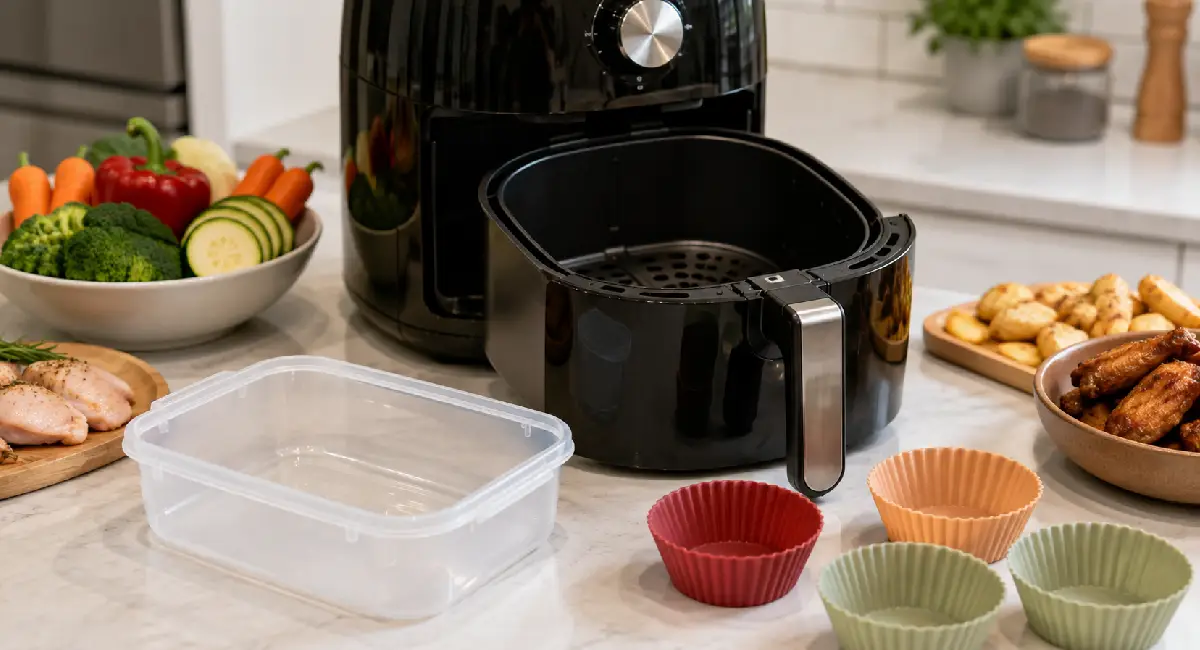
It is important to know what should never use inside an air fryer. Plastic is the biggest one, but there are other mistakes too.
Avoid:
- Using plastic storage bowls.
- Heating food in takeaway containers.
- Trusting microwave-safe labels for oven use.
- Using lids that are not heat-rated.
- Placing containers too close to the heating element.
- Covering the whole basket with a liner.
- Using damaged glass or ceramic.
- Ignoring the user manual.
- Using non-heat-resistant silicone.
- Assuming all cookware is safe for air fryer use.
These errors can harm food, cookware, and your appliance.
Safe Materials vs Unsafe Materials
| Item | Typically safe? | Notes |
|---|---|---|
| Oven-safe metal pan | Yes | Good for baking and reheating |
| Oven-safe ceramic | Yes | Good for small dishes |
| Oven-safe glass | Yes, with care | Avoid thermal shock |
| High-quality silicone | Yes | Must handle high heat |
| Parchment paper | Yes, with care | Must be weighed down |
| Plastic container | No | Usually unsafe |
| Microwave-only tray | No | Not for dry heat |
| Takeout box | No | Not made for air frying |
| Plastic wrap | No | Can melt |
| Loose plastic lid | No | Can warp or burn |
Frequently Asked Questions
Can you put plastic in an air fryer?
No, do not put plastic in an air fryer. Most plastic containers are not designed to withstand the high temperatures and direct heat inside the appliance. They may melt, warp, smoke, or contaminate food.
Is any plastic air fryer safe?
Only use plastic if it is explicitly labeled for oven-safe or high-heat cooking at your recipe temperature. In everyday use, it is safer to avoid plastic and use metal, ceramic, oven-safe glass, or silicone instead.
Is microwave-safe plastic safe for air fryers?
No, microwave-safe plastic is not automatically safe for air fryers. USDA notes that some microwave-only plastics are not heat stable for conventional ovens, and air fryers work more like small convection ovens. [USDA FSIS]
What should I use instead of plastic?
Use oven-safe metal, ceramic, glass, or heat-resistant silicone. For sticky foods, use parchment paper if your air fryer manual allows it and the paper is held down by food.
Can plastic catch fire in an air fryer?
Yes, some plastic may smoke, melt, or catch fire if it touches direct heat or gets too close to the heating element. Stop cooking if you see smoke or smell burning plastic.
Can I use silicone muffin cups?
Yes, silicone muffin cups can be used if they are food-grade, heat-resistant, and rated for the cooking temperature. Make sure they fit and do not block airflow.
Are ceramic dishes safe?
Ceramic dishes are typically safe when they are oven-safe, undamaged, and small enough to fit. Avoid cracked ceramic or pieces with plastic handles.
Can I put a plastic meal tray in the air fryer?
No, do not put a plastic meal tray in the air fryer unless it is clearly labeled oven-safe and rated for the cooking temperature. Most meal trays and takeaway containers are not made for air fryer heat.
Key Takeaways
- Regular plastic should not go in an air fryer.
- Microwave-safe does not mean oven-safe or air fryer safe.
- Use metal, ceramic, oven-safe glass, or silicone instead.
- The container must be designed to withstand high temperatures.
- Keep cookware away from the heating element.
- Leave room for air to circulate.
- Check the user manual before using any accessory.
- Throw away food if melted plastic touched it.
Final Answer
No, you should not put plastic in an air fryer. Most plastic containers are not designed for hot air, dry heat, or high temperatures inside the appliance. Use oven-safe metal, ceramic, borosilicate glass, or heat-resistant silicone instead. If a container is not clearly marked for oven or air fryer use, do not use it.

